
Curriculum
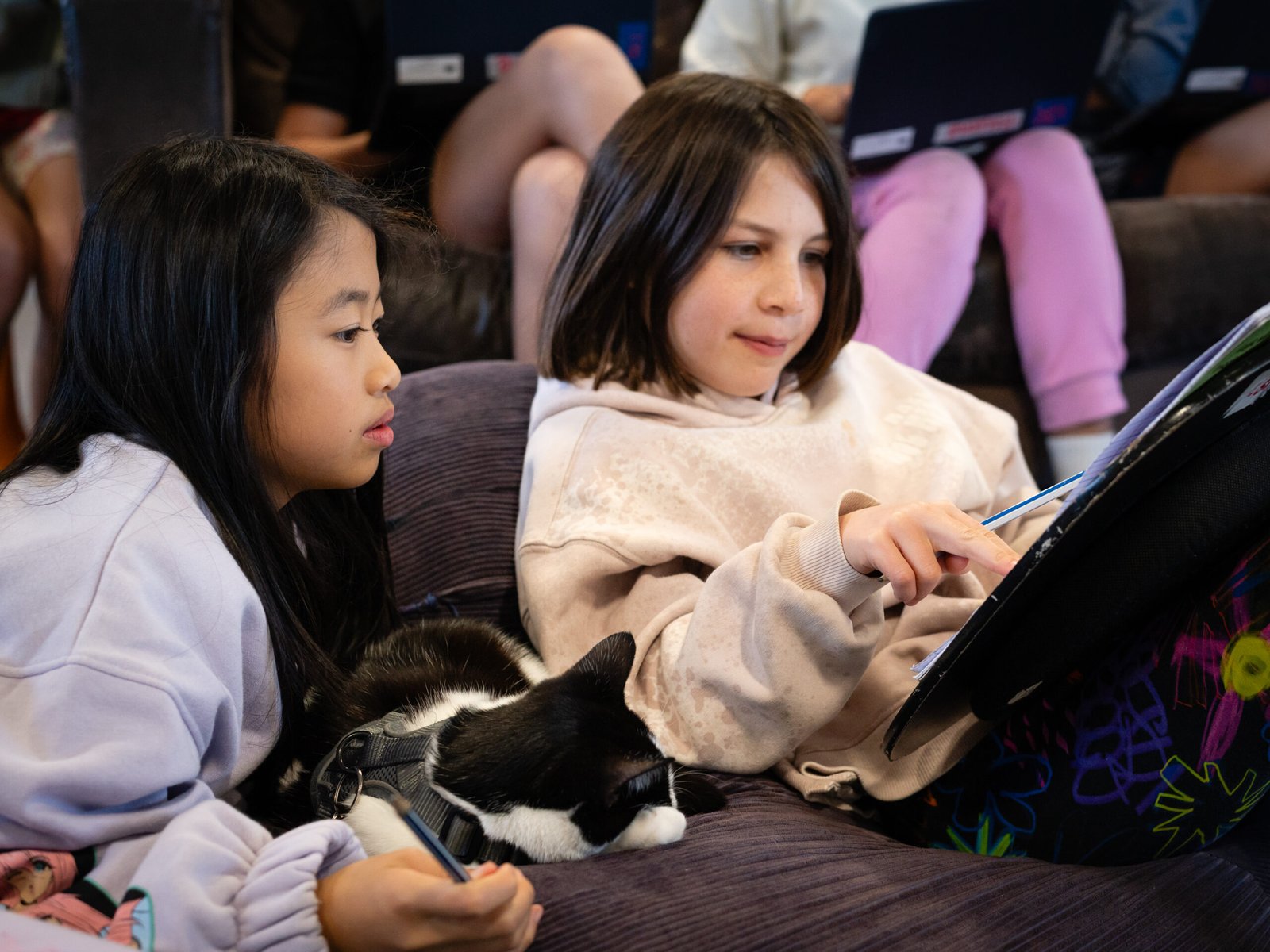
Guided playful inquiry is the way we weave learning methods, concepts and subjects together.
Inquiry learning is an investigative journey into a topic, idea, problem, or issue with a focus on students constructing their own learning and meanings. Inquiry enables students to learn through curiosity, creativity, and collaboration through our inquiry, we aim to cover as many areas of the curriculum as possible.
Along with their class, students follow a year long process of questioning and wondering, exploring solutions and answers, formulating theories and ideas, expressing their insights and discoveries , and evaluating what they have learnt.
In Inquiry teaching and learning, we cover many areas of the Victorian curriculum through a two year cycle.
Odd years
Cycle one – Community
Personal & Social Capability, Humanities – Civics & Citizenship.
Cycle two – Humanities
Humanities – History, Humanities – Geography, Personal & Social Capability.
Cycle three – Social design
Critical & Creative Thinking, Personal & Social Capability, Ethical Capability, Technologies – Digital Technologies.
Cycle four – Transition and change
Personal & Social Capability, Critical & Creative Thinking
Even years
Cycle one – Community
Personal & Social Capability, Intercultural Capability.
Cycle two – Science and technology
Health & Physical Education, Science, Personal & Social Capability.
Cycle three – Design and technology
Critical & Creative Thinking, Technologies – Design & Technology, Humanities – Economics and Business, Personal & Social Capability.
Cycle four – Transition and change
Personal & Social Capability, Critical & Creative Thinking.
As students work through the Inquiry cycle, we engage the three principles of Playful Learning:
1. Learners are leading their own learning: Students are provided with opportunities to experience some agency in what they do, who they do it with and how long they do it for.
2. Exploring the unknown: Students are led by their wonder and curiosity to experiment, explore, create, reflect, solve problems, critically think, and ask questions to prepare them for a world that is completely unpredictable.
3. Finding joy: Students discovering joy in their learning promotes motivation and interest, and is often the result of challenge and struggle.
Every day, students in our Foundation and Junior school classes participate in a session of Guided Play.
Guided Play is the method used by BNWPS to explore and assess the Personal and Social Capabilities domain of the Victorian Curriculum. It is usually held in the first session every morning, and makes for a relaxed and non-confrontational start to the school day.
During Guided Play, the environment is designed by the teacher to spark curiosity and to encourage collaboration and critical thinking. Experiences are varied and provide students with opportunities to interact with a range of materials and engagement opportunities exploring the many modalities of play (eg – dramatic play, construction or sensory play). Where it is possible, these opportunities will be guided by or linked to the school’s Inquiry focus.
At BNWPS, our English curriculum incorporates lessons in reading, writing, synthetic phonics, spelling, speaking and listening. Each day, students participate in workshop style lessons, where they are explicitly taught a skill, and then given time to practise and apply these skills.
We strive to provide students with authentic opportunities to apply their literacy skills and where possible, make links to other curriculum areas. Each week students are given books to take home and read, recording their progress in a reading log as they go.
Our new, magnificent library in the STELA building is a warm, welcoming space where students are invited to come in, enjoy reading, and discover new authors and books. Classes participate in weekly library sessions during which our teachers lead read-alouds and students can borrow books. The library is also regularly open during breaktimes, providing a quiet space for our students to retreat to.
Our students engage in mathematical thinking every day. Our Numeracy program guides students to develop their understanding of mathematical concepts in Number & Algebra, with authentic opportunities to apply their learning of Measurement & Geometry and Probability & Statistics to other parts of the curriculum.
We encourage students to have fun and explore the world with a mathematician’s mind, developing their own theories and using mathematical reasoning and problem-solving to check their thinking.
We understand that for a child to be able to learn, they need to feel connected, safe, valued and heard. These ideas are embodied by school-wide language around wellbeing, and embedded in daily practices such as emotional literacy tools, co-constructed classroom agreements, and growth mindset tools.